An Introspection on Culture in Beyonce's Black is King
A Culture Piece: Decoding Symbolism and Stories in Black is King

Our culture reminds us of who we are: our arts, our customs and our achievements speak through
us and for us, loudly. Our past and our histories journey side by side with our present, a
reflection of our home and heritage, reminding us that we belong to something way bigger than
ourselves. In Beyoncé’s love letter to Africa, Black is King, each and every one of us are
significant, descended from Kings and Queens. We belong. We are Bigger.
Beyoncé’s commentary throughout BIK reflects on important themes such as identity loss and
historical erasure, especially when viewed within the context of slavery and colonial supremacy
during the last few centuries. It speaks to African nations whose cultures, languages and religions
have been torn down throughout the reign of colonial powers.
In remembrance of this lost and fragmented culture, BIK is packed with mythological archetypes,
culture icons and objects from the continent. Although this extraction of folklore and cultural
heritage from various African countries is certainly encouraging, it begs the question of how one
must understand and recognize one’s African cultural legacy if one’s way of life has been
vilified, and whose religions, language, hair, and rituals have been gradually erased to adopt
Eurocentric values. Though the audience of BIK is directed to the African audience, the audience
itself would still need clarity on understanding the meaning and significance of the cultures
presented inside this musical film.
Notwithstanding the album’s artistic curation and ensemble of skillful performances, the lack of
educational information virtually makes this artistic content inaccessible and illegible to the
audience. There is little guiding information provided that aids the audience in understanding the
value of what is put out there on the screen.
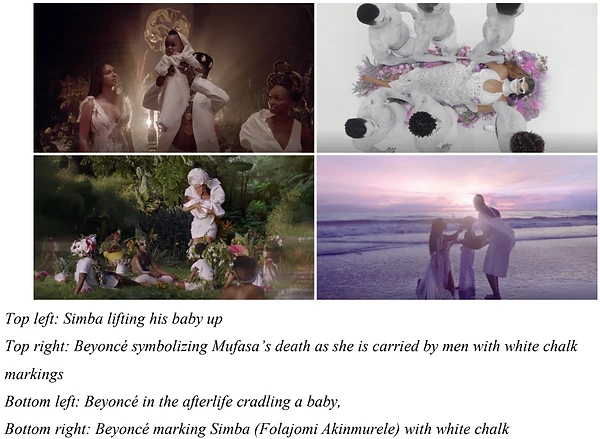
For instance, in the beginning of the track, “Bigger”, Folajomi Akinmurele (Simba) is seen
standing on the shore, receiving white markings from Beyoncé, both as an infant and as a young
boy. In fact, Akinmurele is seen with white markings all over his body and face in other track
sequences such as in “Don’t Jealous Me” as well.
The use of white paint is used in several cultures throughout the continent as powerful references
of African spiritualism. For the Luba people in the Democratic Republic of Congo, the use of
white paint represented a spiritual connection to ancestors. For the Punu people in Central
Africa, where a white clay substance called Kaolin was used, it was associated with healing and
a spiritual existence. Likewise, in Cote d’Ivoire, Kaolin was used by sacred priestesses named
Komains during purification ceremonies.
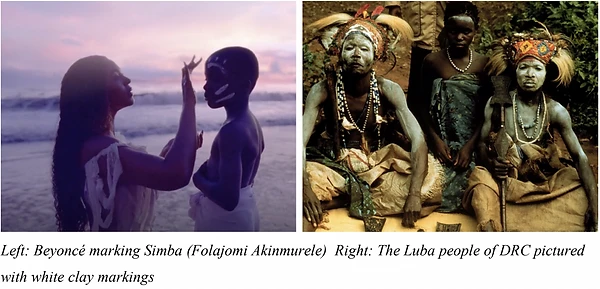
All of these cultures used these markings in representing a spiritual connection with ancestral
spirits. In this case, the use of these white markings appropriately coincides with the recurring
storyline of The Lion King. However, the lack of any descriptions or cultural lessons reduces
these important rituals to merely face and body markings that pass through the consciousness as
what has been considered, “primitive rituals” which don’t have any degree of separation from the
original 1940s depictions of Lion King.
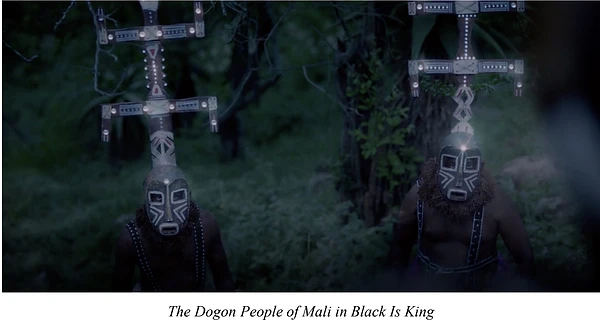
The Dogon people of Mali are another cultural fixture represented in BIK. In “Find Your Way
Back”. Beyoncé is featured alongside two dancers wearing masks known as Kanaga that
symbolize the end of mourning and the passage of the soul to the land of ancestors. Not only are
these individuals the spiritual messengers of the soul to the afterlife, but they were also pioneers
of Astronomy. Their presence in the album complements The Lion King’s storyline of Simba’s
connection to his past ancestors, however, the historical legacy of these people is completely
unmentioned. They appear in the Afrofuturistic landscape of Beyoncé’s track to symbolize the
connection between the cosmic afterlife and present reality. However, their service through the
track as spiritual guides is only subjectively understood and the scene continues on to another
track before their full significance is realized.
As the narrative continues, it becomes difficult to fully absorb the assortment of ever-changing
braiding styles, outfits worn (after all, Beyoncé switched between over 60 looks), aesthetic
performances, and poses. Part of the reason why is due to the rapid space in which a single shot
lasts only a few seconds of screen time. According to a New York Times article featuring critic,
Wesley Morris, this style of editing is in keeping with the “ancient music-video ideas of chaos,
incoherence and looks”. As a result, it becomes even harder to digest the stream of symbolism
and imagery presented in every shot, especially without the added assistance from descriptions or
narrative commentary.
Still, throughout the film, Beyoncé draws on the commonality of traditions shared across the
continent to illustrate a theme of regality, wealth, status and spirituality. For instance, the color white is used in many African cultures, such as Egypt, Democratic Republic of Congo, Gabon and many west African countries as a symbol of mourning, healing and connection to spiritual realms. The white chalk markings on Akinmurele in “Bigger” and “Don’t Jealous Me” and even the all-white funeral shot of Mufasa’s death all serve to show how white can represent important milestones in life. These important milestones can be at the moment of birth, passage to the ancestors in death or can be in the form receiving recognition by the ancestors as a leader.
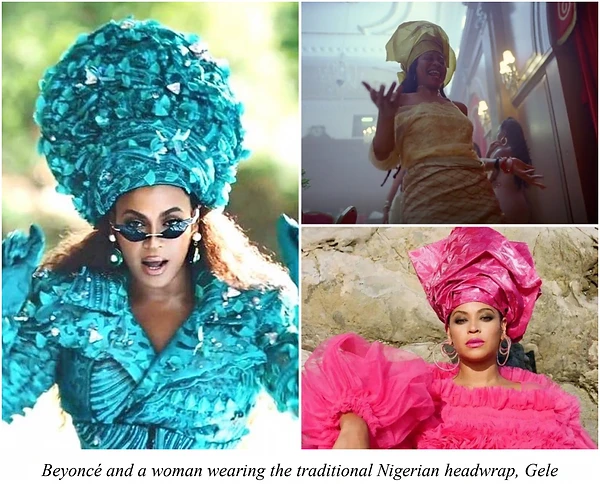
Other displays of cultural commonality are also seen through the headwraps present in BIK.
Headwraps can be a symbol of marriage, status or ethnicity and are present in many African
countries with different names, such as the Gele in southwestern Nigeria, the Dukus in Ghana and
the Doek of South Africa and Namibia, amongst many others.
Beyoncé has incorporated other such numerous inspirations from African cultures by featuring
the head-carrying tradition of women, as well as integrating the cowry shells which symbolize
wealth in west Africa. Additionally, she also wears the horned head to represent the Egyptian
goddess, Hathor as a symbolism of beauty, status and fertility and showcases several hairstyles
which depict status and royalty. Through this, BIK also seems to be centering an important
spotlight on finding common patterns in African cultures that collectively express the regality of
black identity.

Although Beyoncé hasn’t represented every African culture on the continent, which is not
feasible to do anyways, what she did represent, she represented with integrity and the highest
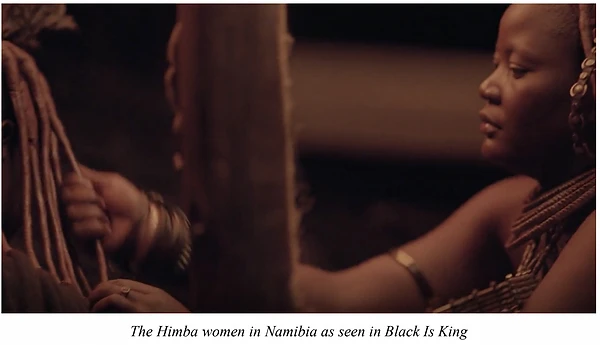
form of authenticity. The Himba people of Namibia, seen in BIK applying red clay on their
braids and skin, are one of the most isolated tribes who work to keep their culture intact by
limiting their contact with the outside world. In order to authentically honor their traditions in
BIK, special permission was granted from the OvaHimba leaders and passports and birth
certificates made for the women to fly out and demonstrate their customs.
Throughout BIK, Beyoncé has been hitting us with looks that definitely impress a certain lush
and picturesque aesthetic of Africa. And certainly, offering the world a glimpse of the unique
customs of different cultures is one of the best attributes of BIK. However, how can one
appropriately garner an understanding of the complexity and interconnectivity of all of these
cultural symbols without the proper descriptions or cultural lessons to complement them?
This is precisely why much of the cultural content could be inaccessible to not only the Afro
Diasporic audience but the African audience as well. Much of the content of Black is King is
inspired from or alludes to African folklore, spiritual mysticism, as well as tradition and customs
from the variety of different ethnicities existing or previously existing on the continent.
Considering that much of this past historical legacy has been fading with time and has been
operating under the strain of neo-colonialism, it isn’t unexpected to wonder whether or not much
of the African audience will recognize their history or other African cultures’ in Black is King.
So, as Black is King is supposed to be Beyoncé’s love letter to Africa, putting cultural lessons
within this musical film would be to the benefit of African people so that they get to re-acquaint
themselves to the cultures existing on the continent and revel in the feeling that they are a part of
something way bigger.